But of Him are ye in Christ Jesus, who of God is made unto us wisdom, and righteousness, and sanctification, and redemption.
- I Corinthians 1:30
Elect according to the foreknowledge of God the Father, through sanctification of the Spirit, unto obedience and sprinkling of the blood of Jesus Christ: Grace unto you, and peace, be multiplied.
- I Peter 1:2
This is He that came by water and blood, even Jesus Christ; not by water only, but by water and blood. And it is the Spirit that beareth witness, because the Spirit is truth.
- I John 5:6

|
Read John 19:34: |
The word "sanctify" means "to cleanse; to purify; to separate; to dedicate." Sanctification refers to the Holy Spirit's work within true believers which progressively cleanses, purifies, and separates them from sin and dedicates them unto God.
Justification and sanctification are two distinct but inseparable gifts of God. Those whom God justifies, He sanctifies. God is both righteous and holy and He created man as such. Mankind lost both his righteousness and holiness in his sinful fall. God's saving and restoring work in the lives of His children is a complete work; it includes both justification (His "making-righteous" work) and sanctification (His "making-holy" work).
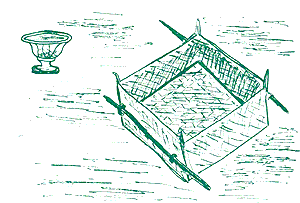
To approach unto a righteous and holy God, both bloodshedding and water-washing are necessary. This was pictured in the Old Testament by the Brazen Altar of Burnt Offerings and the Brazen Laver, the two pieces of furniture located in the courtyard of the Tabernacle. A priest could safely approach God's sanctuary, the Holy Place, only through a way of bloodshedding and water-washing.
How does the bloodshedding (the Brazen Altar) picture justification, and the water-washing (the Brazen Laver) portray sanctification? Why are both necessary?

